
FDA Audit Readiness: A 5-Step Guide for 2026
Audit readiness is the ongoing practice of keeping your facility, documentation, and staff prepared for an FDA inspection at any time, without advance notice. For companies in FDA-regulated manufacturing, readiness is less of a project and more a condition you maintain. This guide sets out a five-step process, along with the roles, room setup, question types, and closing steps that separate a controlled inspection from a stressful one.
Since the FDA does not have to give notice before it inspects, it’s best practice to always be audit ready. cGMP Consulting provides audit readiness training and mock inspections that give teams the skills to perform under real inspection conditions.
What is audit readiness?
Audit readiness means your organization can host an FDA inspection at any moment and demonstrate compliance without delay. A ready facility keeps current documentation within reach, staff who understand their roles, and a quality system that produces reliable records routinely. Readiness reduces the two problems that most often turn a routine inspection into an adverse one: delay in producing records, and inconsistency between what your procedures say and what your staff actually do.
One point may surprise some teams and that is that you are inspected against your own SOPs as well as against federal regulations. If a procedure sets a standard higher than the regulation requires and your staff do not meet it, that gap can become a finding on its own. Readiness means your written procedures and your daily practice match.
Know the language: FDA classifications and outcomes
Understanding how the FDA classifies an inspection helps your team respond calmly and plan next steps. After an inspection, the FDA assigns one of three classifications:
- No Action Indicated (NAI): no objectionable conditions or practices were found.
- Voluntary Action Indicated (VAI): objectionable conditions were found, but the agency is not prepared to take or recommend regulatory action.
- Official Action Indicated (OAI): regulatory or administrative action is recommended.
One of three documents commonly follow an inspection, in order of seriousness:
- FDA Form 483: a list of the investigator’s observations, ordered by risk significance, with a detailed description of each.
- Warning Letter: issued when the FDA identifies significant violations of federal requirements.
- Consent Decree: a legal agreement between the FDA and a company to resolve a dispute and return to compliance.
Responding fully and promptly to a Form 483 is what most often prevents escalation to a Warning Letter.
The five-step audit readiness process
Step 1: Understand the regulations that apply to you
Begin with a clear map of the rules that govern your operation. For most drug manufacturers that means cGMP regulations under 21 CFR Parts 210 and 211, with product-specific parts where they apply, such as 21 CFR Part 212 for positron emission tomography (PET) drugs. Add the FDA guidance documents and international standards your markets require, such as those from the International Council for Harmonisation (ICH). Confirm which requirements apply to your product type, verify that your written procedures reflect the current versions, and make sure each SOP sets a standard you can consistently meet.
Step 2: Build your audit team and set up the rooms
A well-run inspection runs on defined roles and a two-room structure.
The Front Room is where the inspection happens. It holds the auditor, the Lead Host, and a scribe. The Lead Host is the main point of contact and guides the auditor through the day. The scribe takes notes on every conversation and relays document requests to the support team. Plan for one host and one scribe per auditor.
The Back Room is the support engine the auditor does not see. It holds the Back Room lead, subject matter experts (SMEs), and runners, usually three to five people. The Back Room retrieves and reviews documents before they reach the Front Room, prepares SMEs for questions, and runs approved documents to the front. Keep communication between the two rooms on a single group chat and move documents by a named runner so nothing arrives unreviewed.
Name a backup for the Lead Host in case that person is unavailable on the day an auditor arrives.
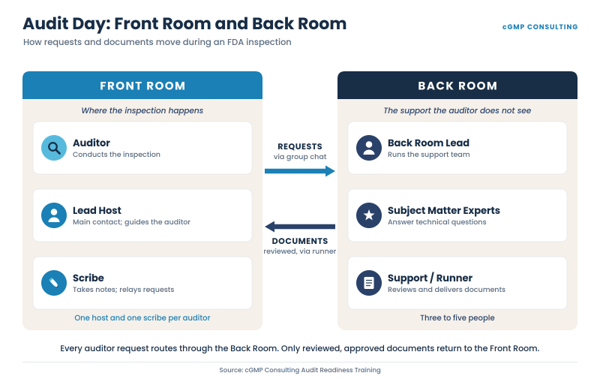
Figure 1. The front room and back room model, showing how requests and documents move during an inspection.
Step 3: Prepare your documentation, arrival plan, and quality review
Preparation covers the plan, the records, and a quality self-review.
Set an arrival protocol before you need it. Decide where an auditor checks in, who is called when an auditor appears at the door, and who escorts them. Prepare an opening presentation, delivered by the Lead Host, that gives a brief overview of the organization, the facility layout, and any changes to the facility, product, or process since the last inspection.
Assemble and control the records an investigator will request first: current organizational charts, facility and equipment layouts, the Quality Manual, SOPs, batch records, validation records, and training files. Log every auditor request in a request tracker that captures the date, a request number, the requester, the Back Room assignee, a description, and the status, such as staged, reviewed, or delivered. Shared visibility lets the Front Room see what is ready and guide the conversation.
Before an inspection, review your quality management system (QMS) the way an investigator will. Walk each area for loose paper, unlabeled items, and general housekeeping, since an investigator can look at anything left in view. Review deviations, out-of-specification (OOS) results, change controls, and Corrective and Preventive Action (CAPA) records for trends. Where a difficult batch or event needs context, prepare an internal storyboard that reconstructs what happened so your team can speak to it clearly. A storyboard is a preparation aid for your team, not a document you must hand to the auditor.
Step 4: Manage the inspection day and answer with discipline
Most inspections open with a facility tour. Identify quality assurance and department SMEs to escort the auditor and always escort them. Follow the material and production flow: incoming material and warehouse, quarantine and approved material, production from manufacturing through finished goods, and the quality control (QC) laboratory. Keep conversation to the area being toured, have the relevant SOP ready for the work in each area, and note every question asked, document reviewed, and employee interviewed.
Investigators use recognizable question styles. Knowing them helps your team answer well:
- Close-ended: a yes-or-no or narrow answer.
- Open-ended: a broad prompt such as “what can you tell me about this process.” Respond by asking whether there is a specific point to cover which keeps the scope tight.
- Leading: designed to draw a reaction. Answer with facts, not opinions.
- Assumptive: states an incorrect assumption to catch you off guard. Correct it plainly by pointing to the procedure.
- Re-statement: the same question asked again to confirm a fact. Stay patient and consistent.
- Rapid fire: several questions at once to prompt a slip. Repeat the question back to confirm before answering.
Coach your team on how to respond to any question. Listen to the full question, pause, and answer only what was asked. Answer within your job responsibility, and direct anything outside it to an SME. If you do not know, say so and offer to find out. Stop speaking once the question is answered, and do not volunteer information or answer a “what if” question.
Be aware of the long silence technique. An investigator may stay silent after your answer, and the pause tempts people to keep talking and add information no one asked for. Be comfortable with the silence or ask whether the investigator has any further questions.
Behavior matters as much as content. Be professional and courteous, correct any error or miscommunication promptly, and talk about what is, not what might or should be. Avoid soft qualifiers such as “typically” or “usually,” which invite follow-up questions. Route every request through the Back Room, show one record at a time and remove it once reviewed, and do not leave an investigator alone in your facility. If a record cannot be found, say you are unable to locate it rather than that it is unavailable, and never guess, argue, or challenge the investigator’s authority.
Step 5: Close out findings and build continuous readiness
The inspection does not end when the day does. Before the auditor leaves each day, the Lead Host should collect any new requests, confirm open topics, and set the next day’s start time. Hold an internal wrap-up with the audit team and SMEs after the auditor leaves to address the day’s concerns and plan how to present open topics.
Request a formal close-out meeting even when no issues were found and invite management. Use it to clarify each observation, ask for the auditor’s initial findings, and confirm the response deadline and next steps. After the inspection, regroup with your SMEs and management, make sure you understand every finding, and draft a constructive response with a clear timeline and CAPA plan. Submit the response within the deadline rather than at the last minute. Treat every inspection as input to continuous improvement so the same issue does not appear at the next one.
Common FDA Form 483 findings to prepare for
Year after year, a familiar set of cGMP deficiencies appears near the top of FDA inspection observations for drug manufacturers. Preparing against these categories closes the gaps investigators most often find:
- Quality unit responsibilities and procedures that are not fully defined or followed (21 CFR 211.22)
- Investigations of discrepancies and out-of-specification results that are incomplete or not extended to other batches (21 CFR 211.192)
- Written production and process control procedures that are absent, unclear, or not followed (21 CFR 211.100)
- Laboratory controls that are not scientifically sound or properly established (21 CFR 211.160)
- Equipment and utensils that are not cleaned, maintained, or qualified on schedule (21 CFR 211.67)
- Personnel without the training, education, or experience to perform their assigned functions
Reviewing your own records against these categories is a practical starting point for internal preparation.
Questions FDA investigators commonly ask
Preparing answers to the questions that come up in most inspections builds real confidence. Expect questions such as:
- Quality policy: what is it, and how is it applied across the quality system?
- Job responsibility and training: how do you know what your job requires, and what is your training curriculum?
- Deviations, investigations, OOS results, and complaints: how many in the past quarter or two years, and how do you manage them?
- Relevant SOPs: what is the procedure for this process?
- Supplier quality: how are vendors qualified and audited?
- Management review: how often do you hold it, what is on the agenda, and who must attend?
- Laboratory: how do you qualify instruments, validate methods, and manage calibration?
- Data integrity: how is data secured, and how do you confirm its accuracy?
How mock audits build real readiness
A mock audit is a direct way to test readiness before it counts. Set a clear scope and objective, covering the areas, processes, and documents you want to evaluate. Use auditors who are qualified and independent from the area under review. Run the exercise like a real inspection: an opening meeting, document review, observation of actual operations, and a closing meeting that summarizes findings as conformities or nonconformities.
A practical mock audit agenda includes a facility tour for cleanliness and GMP, a review of logbooks and maintenance and calibration records, training records, finished product testing results, out-of-specification events, batch record review, and deviations per batch.
The benefits are concrete. A mock audit identifies both strengths and weaknesses, strengthens your SOPs and training programs, corrects gaps before a regulatory inspection, and improves workplace safety. cGMP Consulting conducts mock inspections built around your product type, your processes, and your risks, and our consultants bring direct experience with FDA inspection readiness.
Frequently Asked Questions
Most regulated manufacturers benefit from at least one mock audit each year, and more often when they introduce a new product, change a major process, prepare for a pre-approval inspection, or remediate a prior finding.
Often little or none. The FDA does not have to provide notice before it inspects, so the safe assumption is that any registered facility can be inspected at any time.
They are the three FDA inspection classifications. No Action Indicated (NAI) means nothing objectionable was found. Voluntary Action Indicated (VAI) means issues were found but no regulatory action is planned. Official Action Indicated (OAI) means regulatory or administrative action is recommended.
Correct it before the record enters the Front Room, within the limits of your good documentation practice procedure. Once a record is in front of the auditor, present and defend it as it stands rather than correcting it in the room.
Trained SMEs handle technical questions in their area, the Lead Host guides the day, and the scribe records the conversation. Everyone should answer within the scope of their role and direct anything outside it to the right SME.
Prepare before the notice arrives
Readiness is an ongoing effort. cGMP Consulting helps FDA-regulated companies assess their gaps, train their teams, and run mock inspections that mimic real conditions. Schedule a consultation to build an audit readiness program suited to your operation.