

Computer System Validation (CSV): A Practical, Risk-Based Overview
Computer System Validation (CSV) is the documented process of confirming that a computerized system consistently performs as intended, produces accurate and reliable records, and stays in a controlled state throughout its life. In FDA-regulated industries, CSV is how an organization shows that the software behind its manufacturing, laboratory, and quality operations can be trusted with decisions that affect product quality and patient safety.
Why CSV matters
Regulators and supply chain partners expect computerized systems that influence product quality or generate regulated records to be validated and controlled. In the United States, 21 CFR Part 11 sets expectations for electronic records and signatures, including audit trails, access security, and record trustworthiness. In the European Union, EU GMP Annex 11 establishes parallel expectations for risk management, validation, and data integrity.
Inadequately validated systems can lead to Form 483 observations and, in serious cases, warning letters. Product holds and many other complicating factors could be triggered by potentially questionable data. Sound validation is, in effect, an investment in operational reliability and a foundation of the quality system.
The frameworks that guide CSV
Most programs draw on two reference points in developing their CSV framework. GAMP 5, published by the International Society for Pharmaceutical Engineering (ISPE), provides a risk-based lifecycle model and categorizes software by type, with rigor increasing with complexity and risk. The FDA’s draft guidance on Computer Software Assurance (CSA) also focuses on heavily on risk: less documentation for its own sake, and more critical thinking and risk-based testing. CSA does not replace the goal of CSV; it refines how teams satisfy the requirements.
The CSV lifecycle
Validation is often pictured as a V-model, pairing each specification with a matching verification activity. The process starts in the upper left corner of the diagram, moves in a V-shape to the bottom where Factory Acceptance Test (FAT) and Site Acceptance Test (SAT) rest. Then the process continues to the upper right through the IQ / OQ / PQ to achieve a state of validation. Across the V-shape, it shows the relationships between the activities, giving a complete picture of the process.
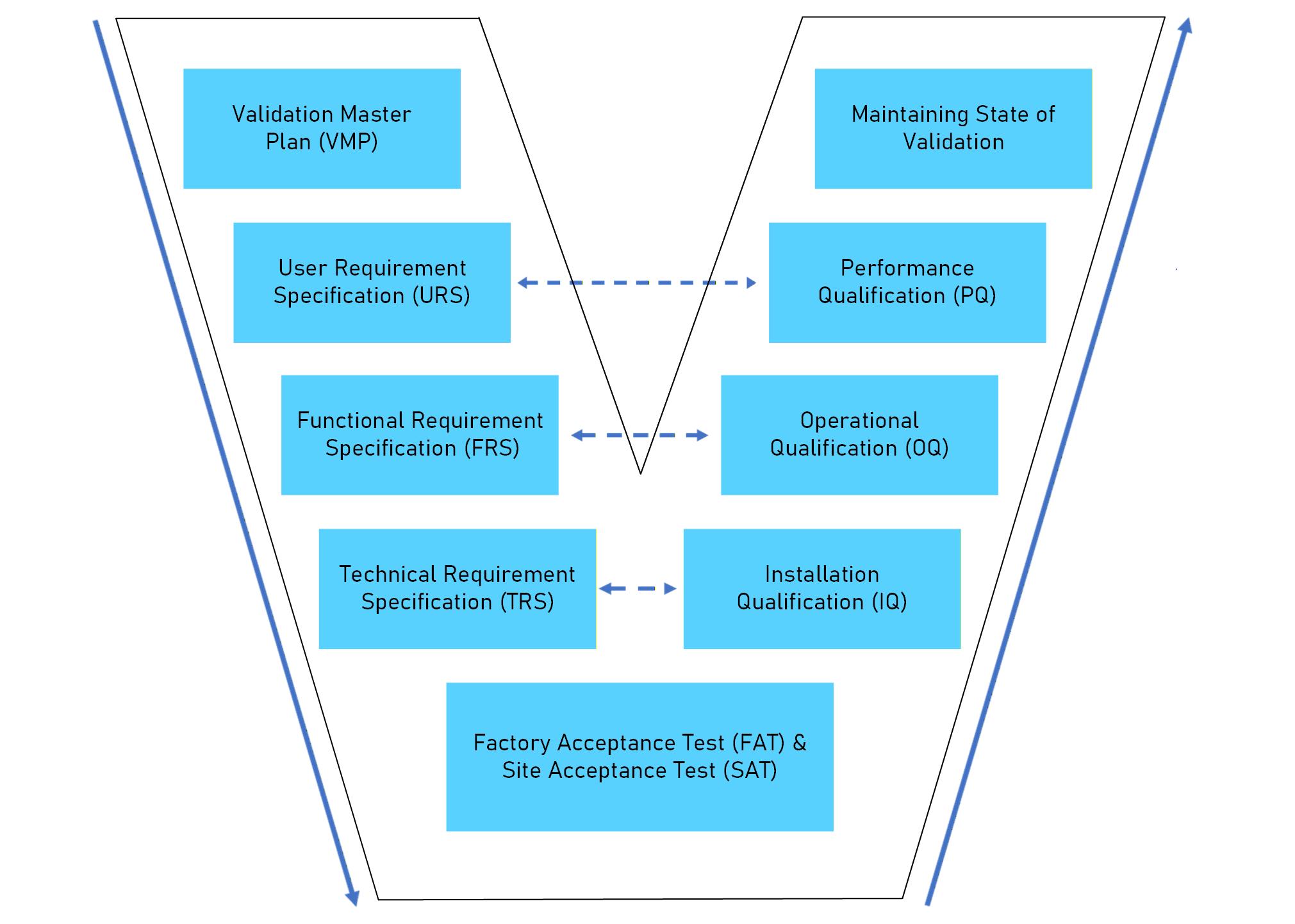
Planning. The process begins with a Validation Master Plan (VMP), which defines the strategy, scope, deliverables, and responsibilities for the effort. This is where the team confirms whether the system is GxP-relevant, categorizes the software (for example, against GAMP 5 software categories), and assesses risk so that validation effort concentrates where patient safety, product quality, and data integrity matter most.
Specification. Document what the system must do through a User Requirements Specification (URS) and, where relevant, Functional Requirement Specifications (FRS) and Technical Requirement (TRS) specifications. Requirements should be clear, testable, and uniquely identified, because they form the foundation of efficient validation and the starting point for traceability.
Factory and Site Acceptance Testing. Before the system moves into qualification, Factory Acceptance Testing (FAT) verifies performance at the supplier’s site prior to shipment, and Site Acceptance Testing (SAT) confirms correct delivery, installation, and basic operation once the system arrives at the facility. Well-documented FAT and SAT results can be leveraged to reduce duplication in later qualification activities.
Qualification. Verify the system against its specifications through Installation Qualification (IQ), confirming correct installation and configuration; Operational Qualification (OQ), confirming the system functions across its operating range; and Performance Qualification (PQ), confirming reliable performance under actual conditions of use. A Requirements Traceability Matrix links each requirement to its corresponding test, as shown by the arrows.
Reporting and release. Results are summarized in a Validation Summary Report (VSR), where any deviations are documented, assessed for impact, and justified or resolved. After the required approvals, the system is formally released for GxP use.
Operation. Validation continues after go-live. Change control, periodic review, access management, audit trail review, and backup and restore keep the system in a validated state, and end-of-life planning governs eventual retirement or decommissioning. A system is only as validated as its current, controlled condition.
A risk-based approach
The most common CSV mistake is not under-validating; it is putting equal effort everywhere instead of where the risk is. Testing low-risk, vendor-supplied features the same as high-risk, custom code consumes time without meaningful impact. A better question for each function is simple: if this fails, what is the impact on patient safety, product quality, or data integrity? High-impact functions receive rigorous testing, while lower-risk functions can rely on leveraged supplier evidence. The result is leaner while still defensible.
Data integrity
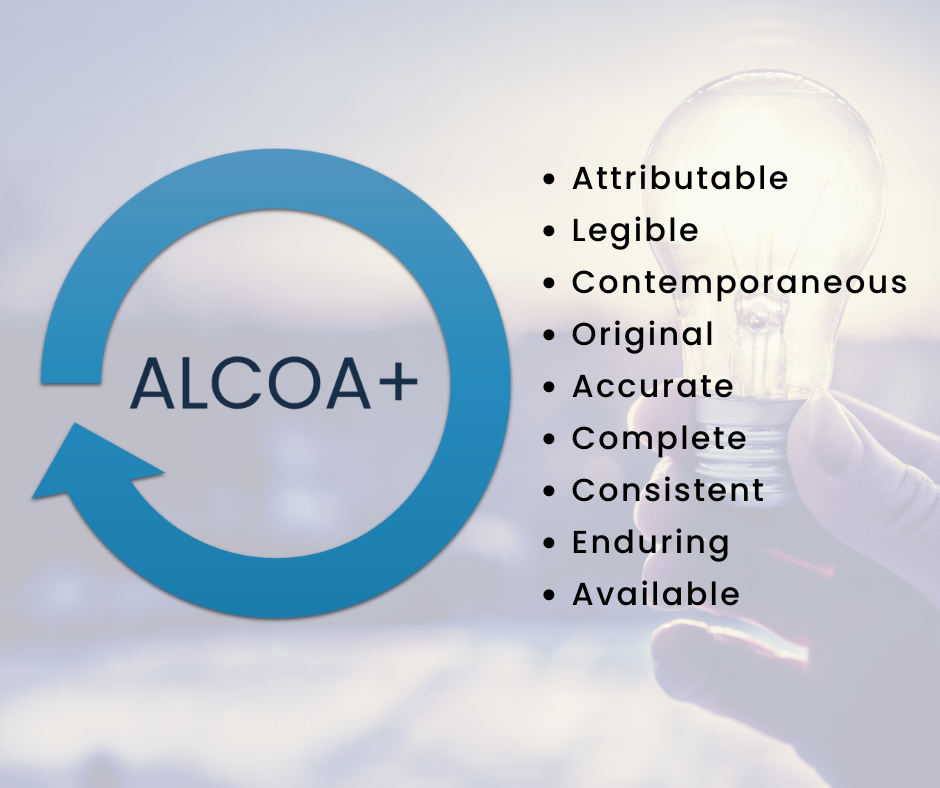
CSV and data integrity go hand in hand. A validated system is what makes trustworthy data possible. The ALCOA+ principles describe what regulated data should be: Attributable, Legible, Contemporaneous, Original, and Accurate, plus Complete, Consistent, Enduring, and Available. Audit trail verification, access controls, and electronic signature testing exist to make these principles reality in daily operation.
Working through CSV with confidence
Effective validation protects timelines and budgets as much as compliance. A clear, risk-based program reduces rework, shortens release cycles, and produces records that withstand scrutiny. The goal is not maximum documentation; it is the right documentation, focused where risk is highest.
cGMP Consulting helps FDA-regulated companies build and execute practical, risk-based CSV and data integrity programs, for any and all elements in the process. To discuss validating your computerized systems, contact our team.
Frequently Asked Questions
The V-model is a lifecycle diagram that pairs each specification activity with a matching verification activity. Requirements descend the left side, from the Validation Master Plan (VMP) through the User Requirements Specification (URS) and functional and technical specifications, and verification ascends the right side through Installation Qualification (IQ), Operational Qualification (OQ), and Performance Qualification (PQ). The horizontal links across the V show which qualification confirms which specification, forming the basis of requirements traceability.
ALCOA+ is a set of principles that defines the qualities regulated data must have to be considered trustworthy. The original ALCOA elements are Attributable, Legible, Contemporaneous, Original, and Accurate, and the “plus” extends these with Complete, Consistent, Enduring, and Available. In computer system validation, activities such as audit trail review, access controls, and electronic signature testing exist to uphold these principles in daily operation.
Validation is the overall objective of showing that a system meets its intended use. Qualification activities such as IQ, OQ, and PQ are the verification steps that provide the supporting evidence.
CSV is the goal. CSA is a risk-based, critical-thinking approach, described in FDA draft guidance, for reaching that goal with less low-value documentation.
Yes. If a spreadsheet performs a regulated calculation or generates data used in GxP decisions, it should be validated in proportion to its risk.